

Visit by Hugues Berry, Head of Inserm’s AI Division
RetourOn Thursday, 8 January,
the BPH welcomed Hugues Berry, head of Inserm’s AI division.
Throughout the afternoon, members of our teams were invited to
present the role of artificial intelligence in their work.
A great opportunity to discuss this new tool in its various applications
and the benefits its use can bring

Hugues Berry : Renowned expertise in AI and health research
Hugues Berry is head of the AI and Digital Division at Inserm, whose goal is to better integrate artificial intelligence into research.
This division helps researchers and their teams use AI to respond to their needs and find solutions, make data and computing infrastructure more accessible, and share best practices.
Issues and questions related to ethics in the use of AI are at the center of Hugues Berry’s work.
His career path illustrates his recognised expertise:
First as head of modelling in a cell biology laboratory, then as a researcher at Inria, where he was already using computer and mathematical models to study intracellular dynamics through modelling. He subsequently continued to specialise in modelling, but this time in neuroscience.
At Inria, he has held positions such as Deputy Scientific Director for Biology and Digital Health, as well as Vice-President of the Evaluation Committee. He has also contributed to structural programmes such as the PEPR Digital Health programme and led research projects focused on artificial intelligence applications, particularly for drug discovery. Since 2023, he has also been in charge of the Inria AIstroSight project team.
Highly engaged, he currently contributes to several national institutions, including Inserm’s specialised committee for health technologies (CSS7) and the Health Data Hub’s CESREES. At the same time, he serves as section editor (Neurosciences) for the journal PLoS Computational Biology.
Many researchers at BPH are now incorporating artificial intelligence into their work.
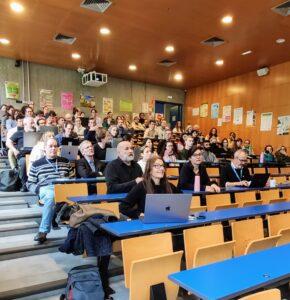
A look back at an inspiring half-day event on AI in public health at Bordeaux Population Health, attended by Nicolas Roussel, Director of the Inria centre in Bordeaux, and Hélène Jacquet, advisor on the use of artificial intelligence in the activities of the University of Bordeaux, who were invited guests and also took part in the discussions.
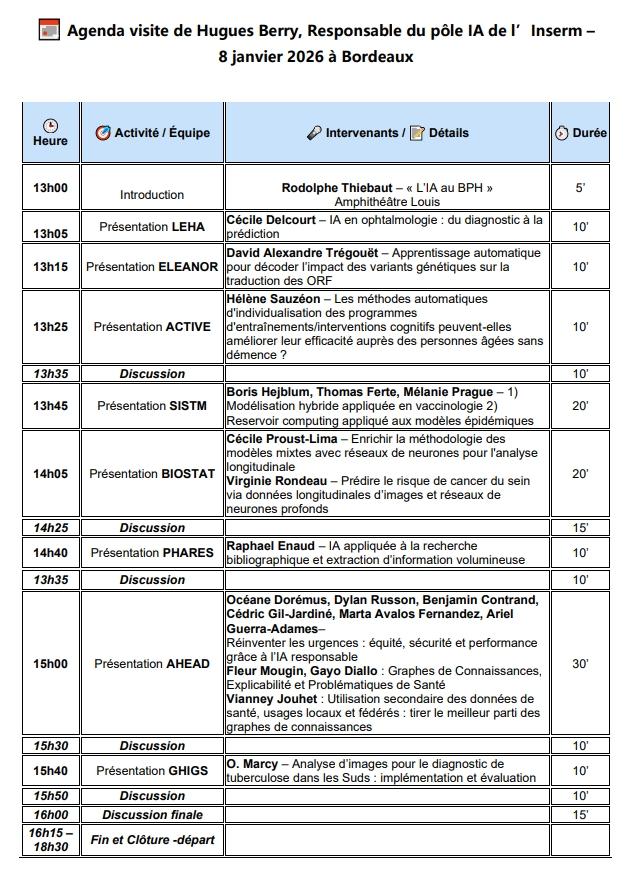
On the programme :
The programme covers AI applications that already span the centre’s public health research continuum, from clinical diagnosis to epidemiological modelling, genetics, longitudinal data analysis, systematic literature reviews and healthcare organisation.
In particular, work will be presented in the following areas:
Imaging and diagnosis
Several teams are using AI to extract high value-added information from medical images.
• Ophthalmology (LEHA): algorithms for diagnosis and prediction for retinal image analysis and patient follow-up.
• Tuberculosis in southern countries (GHIGS): image analysis for diagnosis, with a focus on implementation and evaluation in resource-limited settings.
• Breast cancer (BIOSTAT): deep neural networks applied to longitudinal image data to predict cancer risk.
Genetics, mixed models and longitudinal data
AI is used to better exploit complex genetic and longitudinal data.
• Genetics (ELEANOR): machine learning to decode the impact of genetic variants on ORF translation.
• Mixed models (BIOSTAT): enrichment of mixed model methodology with neural networks for longitudinal analysis.
Personalisation of interventions and modelling
Teams are exploring AI to tailor interventions and improve understanding of health dynamics.
• Cognition and ageing (ACTIVE): automatic methods for individualising cognitive training programmes in elderly people without dementia, to increase their effectiveness.
• Vaccinology and epidemiology (SISTM): hybrid modelling in vaccinology and reservoir computing applied to epidemic models.
Analysis of documentary data and knowledge graphs
AI approaches are also applied to the management and structuring of scientific information and health data.
• Bibliographic research (PHARES): AI for document research and large-scale information extraction.
• Knowledge graphs (AHEAD): construction and use of graphs for explainability, secondary reuse of health data, and local or federated uses.
Organisation of care and responsible AI
Finally, the programme promotes the use of AI to transform the organisation of care and decision-making.
• Emergency departments (AHEAD): ‘reinventing emergency departments’ for greater equity, safety and performance through responsible AI.
Our teams have demonstrated how AI is becoming a tool to be tested for better diagnosis, prediction, understanding… and decision-making in public health.
A dynamic is taking shape in our research centre, with a focus on responsible AI research, particularly from an environmental perspective, but also integrated into institutional policies and data protection. And while this new tool is reinventing the way research is conducted and data is processed, it must be critically evaluated in terms of its performance