

Lecture series “Anthropology and Public Health : which common future ?”
RetourThe BPH-PHARes team is collaborating with its partners at the Faculty of Anthropology at the University of Bordeaux on a series of lectures at the crossroads of anthropology and public health.
Five sessions to explore the mutual contributions of these two disciplines are planned between November 2025 and May 2026 at the Carreire health campus and the Victoire humanities and social sciences campus.
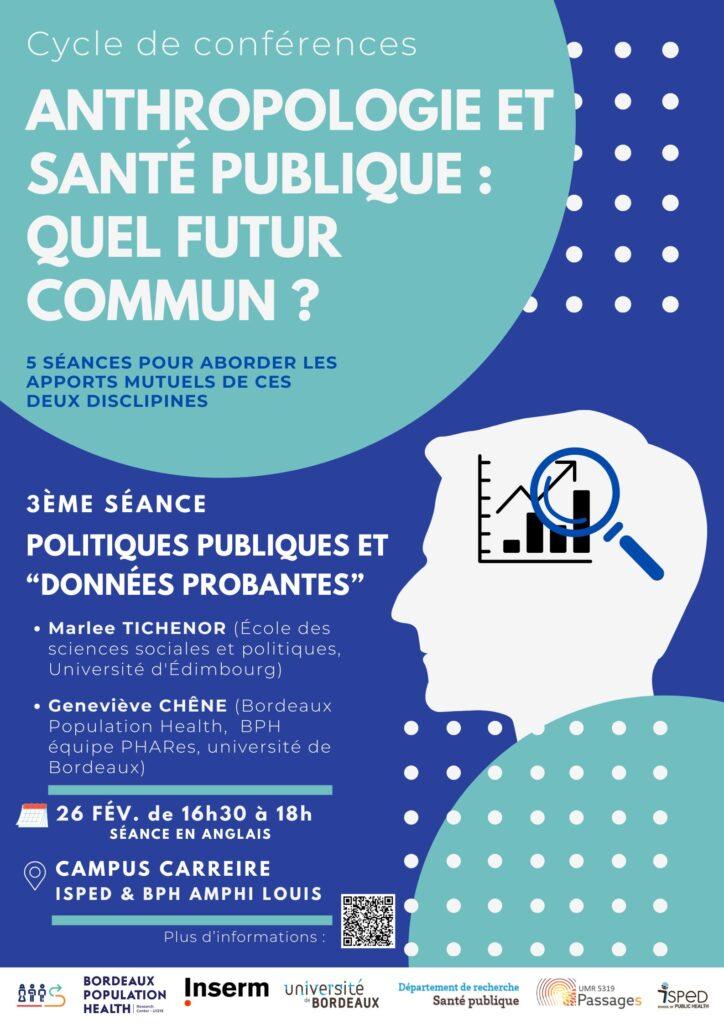
Third session: Lecture series Anthropology and public health: what future do they share?
Steering committee : Fiona Gedeon Achi, Carole Dufouil, Isabelle Gobatto, Andja Srebro
avec l’appui de Marie Manganelli, Nidhi Priya et Elyssa Sillam-Hyjazi
Open to all, in person
📅 Thursday, 26 February 2026, 4:30 p.m. – 6:00 p.m.
📍 Amphi Louis – ISPED – Campus Carreire
A series of five lectures that raise two questions, summarised here in a deliberately provocative manner:
• How can anthropology be useful in public health practice?
• And conversely, how can public health be useful in anthropological practice focused on health, in its broadest sense?
This new initiative is based on three assumptions:
The first is that, although health anthropologists and public health specialists are exposed to different professional practices and constraints, they are driven by a common overall objective: to understand the health and well-being of individuals. While this objective is shared, its implementation in research questions and field practices diverges.
The second, related premise is that, even if there is agreement on a common goal, multiple visions and interpretations lie behind the terms that make up this goal – for example, what is health? What does it mean to promote health?
The final premise is that exchanges between anthropologists and public health professionals need to be strengthened in order to find common ground between objectives and means, imagination and action. This requires a capacity for listening – but also for translation – on both sides, which this seminar aims to encourage.
Each session will be structured around a dialogue between an anthropologist and a public health researcher to encourage collective reflection, asking the following questions:
• What does it mean to be useful (to public health for anthropology, to anthropology for public health)?
• How can anthropological research guide the practice of health professionals?
• Conversely, how can anthropologists incorporate the concerns of public health professionals in order to construct their investigations and make their work accessible, “relevant” and understood?
• In this dynamic process of interaction, what definition and objectives of “public health” emerge?