


Bordeaux, the international hub for a symposium on the exposome and brain health
RetourFrom 17 to 19 June 2026, Bordeaux hosted the 2026 Global Exposome Symposium for Brain Health, which focused on the theme ‘Mapping the Exposome to Prevent Alzheimer’s Disease and Related Dementias’.
For the environmental health research community in Bordeaux and throughout France, this event served to highlight Bordeaux as a centre of expertise in the exposome, population health and the prevention of neurodegenerative diseases.
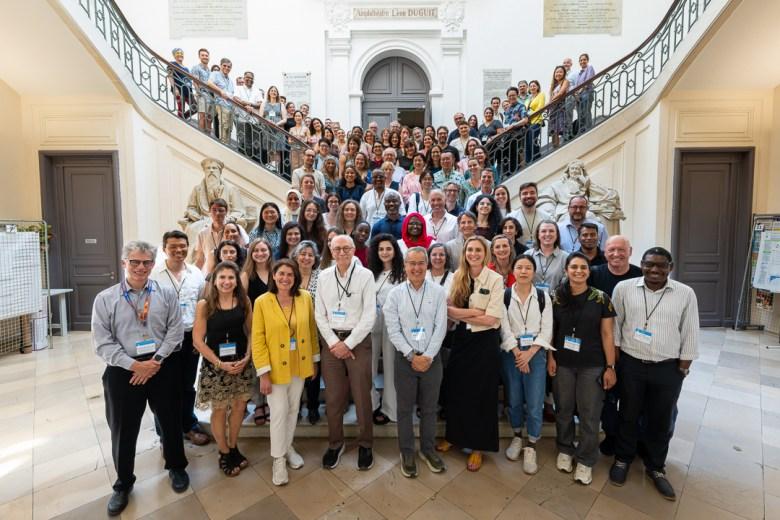
This 11th Exposome Symposium, organised by Mount Sinai, the first of its kind in France, was co-organised by the Institute for Exposomic Research and the Brookdale Department of Geriatrics and Palliative Medicine at the Icahn School of Medicine at Mount Sinai, as well as the University of Bordeaux and Inserm, and aimed to bring together and build a global community focused on the exposome.
Over three days, more than 140 researchers, clinicians, young scientists and public health professionals from 20 countries discussed the role of environmental exposures throughout life in the risk of Alzheimer’s disease and related forms of dementia.
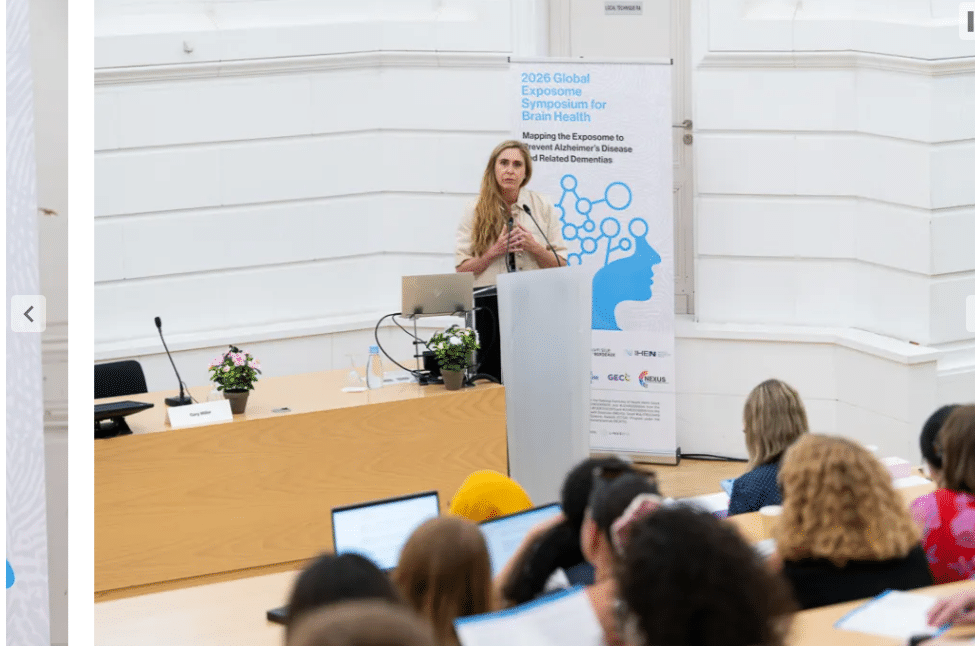
The influence of the exposome on brain health is a key area of research at the BPH
Among the speakers, several members of the BPH were able to share their work and expertise.
All these productive exchanges between scientific communities are helping to advance our understanding of the environmental factors that influence neurodegenerative diseases.
Understanding the concept of the exposome
The exposome describes all the environmental exposures to which an individual is exposed during their life: air pollution, diet, sleep, working conditions, social determinants, the microbiome and stress. The symposium highlighted the central challenge facing current research: no longer studying these factors in isolation, but understanding their combinations, their interactions and their cumulative effects on brain health.
Research on the exposome to prevent and understand diseases, particularly those affecting the brain
The presentations explored, in particular, the developmental origins of Alzheimer’s disease, the link between nutrition and cognition, sleep and neurodegeneration, combinations of exposures during pregnancy, and the gut-microbiota-brain axis.
Technologies for prevention
The programme also highlighted the methodological advances required to better explore the exposome: statistical modelling, geospatial modelling, high-resolution metabolomic analysis, non-targeted chemical analyses, wearable sensors, and other exposome-wide association studies (EWAS) made possible by artificial intelligence.
These approaches pave the way for precision prevention: identifying molecular signatures and risk profiles at an earlier stage, so that interventions can be proposed before symptoms appear.
Building a scientific community
With around thirty speakers, two round-table discussions and 50 poster presentations, the symposium fostered dialogue between the fields of environmental epidemiology, geriatrics, neurology, toxicology, public health and computational sciences.
Among the presentations by BPH members were those by Cécilia Samieri [co-leader of the BPH-ELEANOR team] on chemical exposures linked to brain ageing and dementia, and Carole Dufouil [leader of the BPH-PHARes team] on early biomarkers, diagnostic advances and opportunities for integrating exposomics.
The next generation of scientists
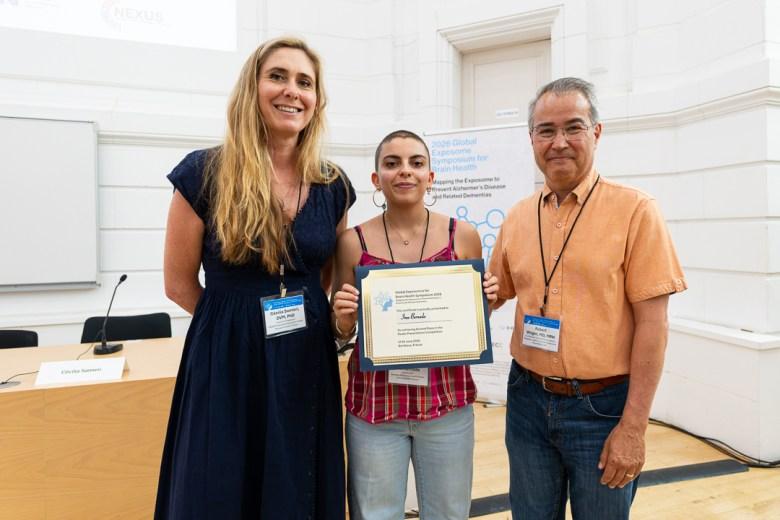
Fifteen early-career researchers and lecturers-researchers from eight countries received mobility grants to present their work. The award-winning posters recognised research into predictive scores for the risk of dementia, the relationship between diet and the metabolome, and biological ageing.
Among them, Ima Bernada, a PhD student in the BPH-ELEANOR team supervised by David-Alexandre Trégouët, received an award for her poster entitled ‘Mapping diet-metabolome relationships using network-based methods in relation to subsequent cognitive decline in older adults’.
Researchers are set to gather in Morocco from 24 to 27 May 2027 for the next edition of the symposium on the exposome and Alzheimer’s and related diseases.

The presentations, which were streamed live to over 300 viewers, along with the recordings and the full scientific booklet — comprising the programme and abstracts of the 50 posters — are available online: 2026 Global Exposomics for Brain Health Symposium – YouTube