


3 questions for Denis Rustand about his book: Bayesian Survival, Longitudinal, and Joint Models with INLA
RetourFor the publication of his first book, Denis Rustand, a biostatistics researcher in the BIOSTAT-BPH team,
answers our questions about this book devoted to an innovative method in the field of statistics
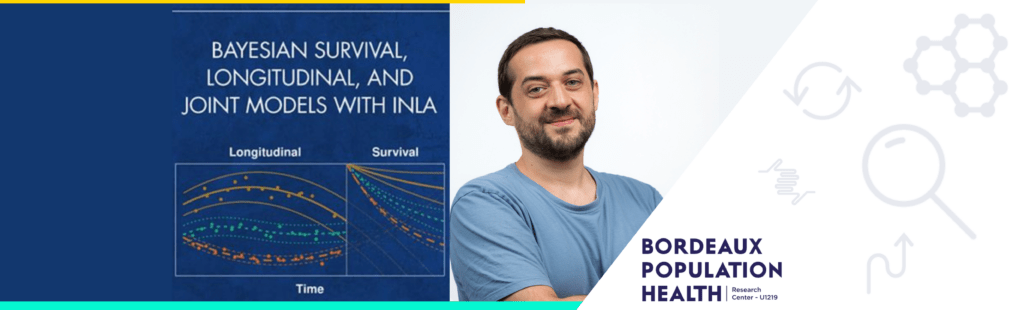
picture by Gautier Dufau
Denis Rustand is a biostatistics researcher within the BIOSTAT team at the BPH, whose research focuses on the development of fast and flexible Bayesian methods for the joint modelling of complex longitudinal and survival data.
After four years of collaboration within the BAYESCOMP group at KAUST, Denis Rustand assembled a team of colleagues with complementary expertise to produce his book:
Håvard Rue, director of BAYESCOMP and creator of the INLA method, whose world-renowned work has revolutionised computational Bayesian statistics.
Janet van Niekerk, associate professor at the University of Pretoria, for her expertise in complex survival analysis and her contribution to improvements in the INLA algorithm.
Elias Teixeira Krainski, a researcher at BAYESCOMP and an expert in spatial statistics, who enabled the integration of geographical and spatial heterogeneity into the models.
Bayesian Survival, Longitudinal, and Joint Models with INLA is therefore a key publication, presenting tools that can be directly used to analyse data from the large cohorts and clinical trials studied at the BPH. This enables better modelling of disease dynamics, management of missing data, and opens the way to personalised medicine through the dynamic prediction of clinical risks in real time for a specific patient.
What in your background led you to write this book?
The idea of writing this book is a direct continuation of my research career. I completed my PhD in public health and biostatistics here at the University of Bordeaux, where I worked on developing so-called ‘conjoint’ models to analyse changes in biomarkers and survival data in oncology simultaneously. I quickly encountered an obstacle: with traditional estimation methods, computation times become very long as soon as the models are made slightly more complex to make them more realistic.
To overcome this, I joined a post-doc research group specialising in Bayesian computation at KAUST University in Saudi Arabia, under the supervision of Professor Håvard Rue, the creator of the INLA (Integrated Nested Laplace Approximations) methodology. There, I was able to combine my expertise in theoretical biostatistics with high-performance Bayesian computation, which led to the creation of the R package INLAjoint.
Writing this book was a natural extension of this work: it was necessary to provide the scientific community not only with this software tool, but also with the theoretical foundation and practical guide required to make full use of it.
Does this book address any needs you have identified in the fields of statistics and public health?
If so, which ones, and why did you choose to publish it as a book?
Absolutely. Today, biomedical research, particularly in epidemiology and clinical trials, relies on increasingly rich and multidimensional data: multiple biomarkers are monitored at high frequency over time, whilst the occurrence of various clinical events (death, relapse, etc.) is observed.
The main obstacle to the multivariate analysis of this data was not a lack of theory, but a genuine computational bottleneck. Researchers were often forced to make a frustrating compromise: using simplified models that were less clinically realistic, simply because they were “computable”. The INLA methodology removes this barrier by offering Bayesian approximations that are both ultra-fast and extremely accurate.
We opted for the book format because a simple software ‘user manual’ was not enough. We needed to bridge the gap between advanced statistical theory and practical clinical applications, guiding the reader step by step on how to build these models (longitudinal, survival, joint models, and even spatial models), whilst providing fully reproducible R code.
What do you hope to convey through this book, and who is the target audience?
This book is for anyone who needs to analyse repeated measures and survival data, such as Master’s and PhD students, researchers and applied statisticians in the fields of biostatistics, epidemiology and public health.
What I hope to convey, above all, is the opportunity to formulate much more ambitious research hypotheses. Until now, faced with particularly difficult estimation methods, multivariate analysis has often required methodological compromises. By providing a radically more powerful estimation framework, this book enables us to break free from these constraints.
I thus hope to give the community the confidence to build models that truly reflect the biological and clinical reality of patients. And to ensure that this transition to advanced models is as fluid as possible, we have made every example in the book fully reproducible thanks to our open-source code shared on GitHub.
Finally, in the same spirit of sharing and with our publisher’s consent, we are offering an online version of the book, which is entirely free and accessible.
Free online version : rustand.fr/INLA_book.